LIMITED SPOTS
All plans are 30% OFF for the first month! with the code WELCOME303
LIMITED SPOTS
All plans are 30% OFF for the first month! with the code WELCOME303

LIMITED SPOTS
All plans are 30% OFF for the first month! with the code WELCOME303

Legacy platforms quietly restrict revenue growth, inflate operating costs, and block AI-centric product plans. This article outlines the business arguments for modernization, the methods mid-size B2B firms actually use, the traits of a capable partner, and the five vendors most often cited in 2026 as providers of the best B2B legacy system modernization services.
Leadership teams in mid-size B2B product companies walk a narrow path: they must deliver new features faster than large incumbents but without the financial buffer those incumbents enjoy. Customer expectations rise every release cycle, and investors now view AI adoption as a hygiene factor rather than a differentiator. As technical debt accumulates, even well-loved products become hard to evolve, and their infrastructure costs creep upward.
That tension explains why modernization, once a discretionary spend, has become an executive-level priority. A monolith built in 2017 can be “legacy” if it cannot autoscale, support zero-downtime releases, or provide the data flow required for responsible AI. Over the next sections, we examine what drives modernization decisions, how teams execute them, and which legacy system modernization firms consistently deliver measurable improvements.
Modernization budgets seldom appear out of thin air. They are allocated after a pattern of delays, incidents, or lost deals forces a candid discussion in the boardroom. Understanding those triggers helps build an airtight business case.
A platform becomes “legacy” the moment its architecture blocks current goals, regardless of how old the code is. Typical signals include:
Release cycles that stretch beyond a month despite growing customer demand.
Manual failover procedures that require a 2 a.m. war room.
End of support for proprietary middleware, increasing security risk.
Data locked up in schemas that are hard to analyze or are not suitable for AI pipelines.
Fragmented legacy architecture acts as a massive technical debt tax, derailing enterprise deals and causing critical revenue to slip during architectural due diligence.
The drag shows up on several fronts, and it compounds over time. Maintenance spending creeps higher as specialized contractors are hired to keep vintage application servers alive. Engineers spend large chunks of the sprint chasing intermittent bugs in libraries no one on the team originally implemented, which means fewer new features reach customers.
Deals take longer to close because every prospect asks the same pointed questions about single sign-on, audit trails, and AI readiness. Performance bottlenecks slip into the user experience, nudging unhappy clients toward competitors that promise faster page loads. And when regulators introduce fresh data-handling rules, on-prem databases or aging encryption modules require re-engineering, the company can no longer postpone. Those blockers resonate even more in financial technology. Vendors offering legacy system modernization services for fintech companies report that regulatory deadlines alone can mandate an architecture overhaul.

Executives typically see that there is a need for modernization after having dealt with a cluster of technical and financial headaches:
Each minor release is now a full-stack deployment risk with single-point monoliths.
The vendor-specific middleware drives up licensing expenses and sets roadmap schedules.
It becomes difficult to identify cross-sell opportunities and perform account-based marketing as intended when data is stored in a number of silos.
Manual processes are limited to manual deployments and slow down security patching.
Old logging is not able to capture root causes and prolongs incident resolution.
The talent pool is shrinking: it is difficult for companies to hire engineers who still have knowledge of the tech.
Modernization corrects these deficits while establishing an architecture ready for the next five to seven years of product evolution.
No single playbook works for every company. Pragmatic teams mix approaches, phasing each one to control risk and cost. The comparison table helps non-technical stakeholders map tactics to business priorities.
| Strategy | Typical Timeline | Relative Risk | Immediate Wins | Best Fit Scenarios |
| Lift-and-Shift Cloud Migration | 2-4 months | Low | Eliminates cap-ex hardware, adds auto-scaling | Hardware lease is expiring; code base still maintainable |
| Re-platforming (e.g., managed DB, containerization) | 4-8 months | Medium | Cuts ops toil; improves latency | Monolith slows under load but logic is solid |
| Targeted Refactor | 6-12 sprints | Medium | Unsticks feature velocity | Specific modules block new features or integrations |
| Strangler-Fig Rebuild | 9-18 months | High | Modern, testable microservices | Core design prevents incremental change |
| Data Architecture Overhaul | 3-6 months | Medium | Real-time dashboards; AI-ready data | Businesses want usage-based pricing or AI features |
Migrate to AWS, Azure or GCP to have regional redundancy and reduce hardware refresh cycles. But legacy system modernization consultants B2B are not satisfied with a simple copy:
Rightsize compute based on actual load, not "rack-server-equivalent.
Use IaC early - Terraform modules/Bicep templates ensure environment repeatability.
Keep observability at the heart of things from the beginning, to prevent “lift, shift, and drift.”
Identify quick wins, like moving away from self-managed MySQL to managed Aurora, to reduce admin overhead.
Schedule a FinOps review for 90 days after to validate cost assumptions.
AWS benchmarking also validates that by migrating and incrementally modernizing legacy workloads, the costs of infrastructure are reduced by 31 percent.
Refactoring allows you to make the code easier to maintain without throwing out useful code. Hotspots often include:
Libraries that are dependent on hash functions based on the SHA-1 algorithm.
CPU time is being consumed by reporting modules because of blocking calls on the database.
Memory use is unlimited in image processing routines.
Feature toggles that aren't configurable but hardcoded make A/B testing more difficult.
Error handling that is thrown to flat files and cannot be searched.
In the meantime, smaller refactors provide immediate relief (page-load times improve, support tickets decline), while the larger redesigns are still in the planning stages.
Modern enterprise buyers are looking for modular, API-first integrations to allow them to remain agile and scalable when it comes to new software deployments. It's a big deal to have an API-first stack:
Use central identity using OAuth 2.0 or OpenID Connect.
Publish a contract using OpenAPI and version it.
Send traffic over an API gateway with a dual-layer DDoS protection.
Support customers' preferred languages: JavaScript, Java, Python, Go.
Expose webhooks for event-driven workflows to cut polling overhead.
Product managers find a clear link between clean APIs and expansion revenue.
Nightly batches are no longer acceptable with analytics workloads. Teams move relational stores to managed clusters with read replicas and event streams to Kafka or Pulsar, move OLAP workloads to Snowflake, and then bind it all with strict data contracts. Once latency falls to seconds, finance can roll out usage-based pricing, and product managers can design AI features that rely on up-to-the-minute telemetry.
Sometimes, only a rebuild solves systemic debt. A strangler-fig approach wraps the monolith with new microservices, progressively routing traffic away from it. Success hinges on well-defined domain boundaries, disciplined dual-write patterns, and business-centric progress demos that keep non-technical stakeholders supportive even when the roadmap spans quarters.
Many RFP responses read like carbon copies. Distinguishing a vendor that will own business results from one that will merely staff developers is vital.
The right advisor understands multi-tenant isolation, contractual SLAs, renewal cycles, and the politics of phasing out features some customers still depend on. Without that background, engagements drift or, worse, introduce surprises at compliance time.
A credible legacy system modernization company demonstrates multi-cloud fluency, balanced cost projections, and documented recovery drills. Their architects can explain why they choose a particular managed service and how it will age economically over thirty-six months. They show previous projections that landed within ten percent of real invoices.
Look for defaults, not experiments. Mature vendors arrive with Infrastructure-as-Code modules, automated vulnerability scanning baked into pull requests, and a rollback process tested before production traffic is invited in. Everything from secret storage to release notes should be automated.
A refactored API layer paired with an outdated interface can stall adoption. Partners that carry a lightweight design system, run quantitative funnel analysis, and bake accessibility checks into component libraries reduce that risk. They also know when to sunset features that confuse users and eat up maintenance budget.
Mid-size vendors often win deals by out-integrating bigger platforms. A strong partner brings ready connectors for Salesforce, ServiceNow, Workday, and Okta, plus a demo environment where prospects can test integrations without legal paperwork. That capability alone shortens sales cycles.
The five vendors below are repeatedly referenced in analyst briefings, peer forums, and customer retrospectives as delivering best-in-class outcomes for legacy system modernization services for mid-size b2b product lines.
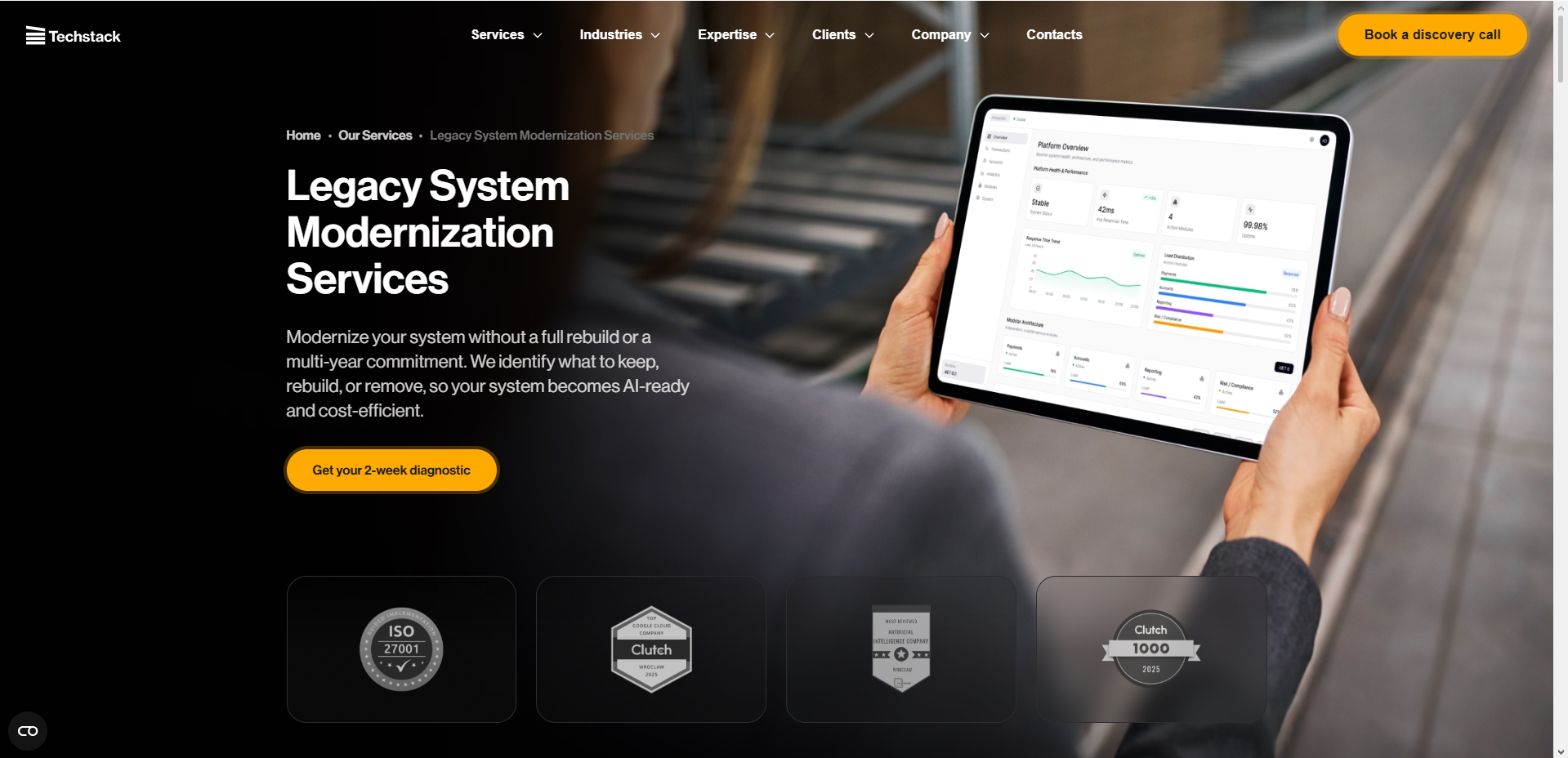
Source: Techstack
Headquarters: Wrocław, Poland (U.S. presence)
Specialty: Diagnostic-led modernization and AI enablement
Techstack has engineered a two-week architecture diagnostic that de-risks large modernization projects by revealing what to keep, what to refactor, and what to scrap before the first epic is scoped. That clarity resonates with CFOs who fear open-ended engagements.
Key offerings fit three recurring scenarios:
AI Readiness. Designs data pipelines, semantic layers, and API wrappers to support AI copilots without touching the core database.
Cloud Migration. Carries out lift and shift or re-platform to AWS/Azure/GCP, including rollback plans.
Full Modernization. Applies strangler-fig steps plus AI-augmented migration accelerators.
Notable outcomes include a five-year transformation of a California sales-enablement provider where Techstack:
Increased analytics throughput 3×
Achieved 90% stability across peak loads
Supported 1,000+ concurrent users without downtime
Additional case studies show a finance platform migration to .NET 6, producing 30% faster feature delivery and a Glassfish-to-JBoss move that cut deployment errors by 30%.
Why it matters: Techstack offers companies a quantified roadmap first and an offer to scale thereafter. In 2026, that discipline secures its place among the best B2B legacy system modernization services providers. Techstack appears repeatedly here because many executives cite its assessment model as the blueprint for risk-aware modernization.
Techstack is also ISO-certified, and retains 60% of its clients for five years or more - rare longevity for a firm specializing in legacy system modernization.
Source: SoftServe
Headquarters: Austin, Texas
Specialty: Modernizing .NET, VMware, and mainframe estates into cloud-native services
To support the 12,000 people in its workforce, SoftServe has its in-house modernization accelerator, SAMP, which helps to accelerate container adoption and enable platform engineering teams to build scalable, future-proofed platforms. Through SoftServe's integration with CAST Highlight, dependency analysis and code assessment are done in a matter of days; modernization decisions can now be made in just a day instead of weeks. Being an AWS .NET Transform has deep expertise in the cloud stack, thanks to its launch partner.
Noteworthy statistics:
Converted 120,000 lines of legacy code. Used AI-enriched tooling to cut the time to complete NET from one week to 18 minutes.
Reached up to 5× faster time to market for new features and services with SAMP on Azure Kubernetes Service (AKS), a general benchmark published across the company's platform engineering engagements.
Demonstrated up to 30% cloud infrastructure cost reduction for clients migrating legacy workloads, a figure SoftServe attributes to its cloud migration and modernization practice overall.
Advantages SoftServe brings to the table:
CAST Highlight integration to grade technical debt in hours, not weeks.
450+ Microsoft certifications plus three MVPs validating domain output.
Proprietary security baselines aligned with HIPAA and PCI for regulated clients.
FinOps skills to forecast cloud spend over multi-year horizons.
SRE playbooks that incorporate incident-response drills and game days.
SoftServe is often the choice for legacy system modernization companies that have a large Microsoft footprint or want a large bench of resources for multi-workstream programs.
Source: Grid Dynamics
Headquarters: San Ramon, California
Specialty: High-volume, Azure-focused modernization with outcome-based pricing
Grid Dynamics is publicly traded (Nasdaq: GDYN) and compensation is competitive. GAIN Platform automatically generates project scaffolding, code-review templates, test harnesses, and boosts productivity by 30% according to internal estimates.
Execution track record:
Migrated Fortune-1000 monoliths to microservices, cutting time-to-market by an order of magnitude.
Integrated with Microsoft’s Azure Accelerate, allowing mid-size clients to tap free deployment credits.
Grew AI service revenue from 25% to 29% in a year by embedding LLM-driven code analysis and auto-documentation.
Grid Dynamics makes sense for B2B companies handling thousands of concurrent financial transactions and seeking a legacy system modernization company willing to share outcome risk.
Source: Persistent Systems
Headquarters: Pune, India (global delivery)
Specialty: MACH focused multi-product modernization & Data Platform Transformation
Built on 30 years of product-engineering experience, Persistent offers Technical Depth and Business Outcome. It is a Leader and Star Performer in Everest Group's Data & AI Services for Mid-Market Enterprises PEAK Matrix 2025 and has been named a Challenger in Gartner's Magic Quadrant for Custom Software Development Services 2025.
Impact snapshot:
Working with a worldwide analytics vendor to map out 400 legacy systems all in one roadmap, with $100 million in net-new revenue.
Improved query performance by up to 5× using cloud-native data flows instead of pipelines in appliances.
Presented an enterprise modernization program that gave a clear path to migration for ~400 legacy systems, thus reducing the risk of customer churn.
Persistent differentiators:
Future extensibility is guaranteed with MACH methodology (Microservices, API-first, Cloud-native, Headless).
Built-in accelerator library with CI templates, observability dashboards and micro-gateway adapters.
25,000+ global headcount enabling around-the-clock development.
Joint innovation labs with clients to co-design revenue-generating modules.
Formal knowledge-transfer sessions so client teams gain autonomy.
Mid-size B2B companies with several related products often pick Persistent when they need one firm specializing in legacy system modernization across a portfolio rather than a single application.
Source: Avenga
Headquarters: Cologne, Germany
Specialty: Incremental modernization in regulated verticals with minimal downtime
Avenga has proven to have a particularly strong presence in markets where the tolerance for risk is low, and operating windows are short. In 2025, ISG awarded the company the accolades of Rising Star in Data Science and Rising Star in Data & Analytics Modernization.
Key engagement:
Re-designed monolith Rails app to develop a high-throughput single-page application for global media company, designed simplified interface for users to manage campaigns, with more intuitive and flexible application, and optimised backend.
Reduced infrastructure costs by using container clusters that auto-scale, and eliminated over-provisioned VMs.
Modular component library for increased front-end flexibility and decreased front-end cycle times.
Why clients go with Avenga:
Nearshore data-sovereignty-compliant delivery centers in Europe.
A pre-approved, GDPR-compliant approach that is component-level.
With AI-assisted code review, defects can be identified early in the process.
Multi-year relationships in banking, telecom, and life sciences have a degree of maturity in regard to compliance regimes.
Roadmap with steps to ensure coexistence with the existing stack, not "big bang" effects.
For B2B vendors in highly regulated spaces who must balance modernization speed with stringent uptime, Avenga often tops the list of best B2B legacy system modernization services providers.
Final selection should weigh much more than rate cards. Executives typically progress through six checkpoints:
Strategic fit. Does the vendor show fluency in your business model and monetization levers?
Proof of value. Are reference metrics similar to your own KPIs?
Governance. What escalation paths exist if velocity dips or scope creeps?
Knowledge transfer. Will internal teams co-own the new stack by program end?
Cultural compatibility. Are communication cadences and tooling preferences aligned?
Cost realism. Historical variance between the quoted SOW and actual invoice should be inside 10%.
CIO Magazine notes that empowering a modernization steering committee with structural governance prevents quiet project drift and costly scope changes. Setting one up early pays dividends.
While there are a number of tools that are used in different programs, several technologies have emerged repeatedly in successful programs:
Managed Kubernetes (EKS, AKS, GKE) combined with service meshes like Istio or Linkerd takes care of TLS, retries, and traffic shaping. With Declarative Infrastructure-as-Code with Terraform or Pulumi, configuration drift is avoided, and Argo CD or Flux allows for GitOps pipelines to automatically deploy pull requests without the need for human gatekeepers.
One way to ensure that any service owns its data is to use a bounded context. Versioned contracts (typically OpenAPI or gRPC) expose functionality and domain events stream through Kafka topics to allow teams to change independently.
Containers are a way to enforce parity of the environment. Self-healing and horizontal pod autoscaling (HPA) and rolling updates, which enable routine releases during business hours, not on the weekend, are also introduced in Kubernetes.
Copilots running on LLMs can also help write release notes, translate legacy SQL, and provide recommendations for limits for Kubernetes resources based on Prometheus data. The CIO Magazine states that AI observability and automated ServiceOps can cut incident MTR by more than 60 percent.
Outcomes vary, yet four benefit categories recur:
Revenue lift. ARR is increased with the release of new modules earlier.
Operating leverage. Legacy license retirement lowers costs of goods and thus increases gross margin.
Security posture. Support with runtimes and automated patch pipelines, known CVEs are closed quickly.
Talent attraction. Modern stacks are preferred by engineers, which increases the hiring velocity and helps to retain them.
Capturing before-and-after metrics. Lead time, infra cost as a percentage of revenue, and customer NPS are some of the numbers that can help demonstrate ROI to non-technical stakeholders.
Sometimes teams will get used to pain until it is time for another team to raise the topic. Common signals:
There was a decline in release frequency from bi-weekly to quarterly.
The number of support tickets per active user doubled year-over-year.
Compliance checks result in compensatory control, which leads to higher audit expenses.
When prospects request an integration roadmap, sales deals come to a halt.
Outdated tech.” is cited by developers as a reason to open up job searches.
Under 20% unit-test coverage - results in manual regression cycles.
If three or more of these appear concurrently, modernization is overdue.
Technology shifts never pause; today’s best practice becomes tomorrow’s technical debt. Understanding where the industry is heading helps teams design architectures that age gracefully rather than painfully.
Large language model assistants already suggest incident remediations, but the next wave integrates directly with CI/CD pipelines. Imagine an on-call engineer approving a bot-generated rollback for just the microservice, causing a spike in p95 latency. Some early adopters now route a fifth of low-severity incidents to these automated fixes, freeing humans for feature work.
The monolithic suite is fading. Packaged business capabilities - self-contained functions exposed as secure APIs - let customers assemble precisely the workflow they need. Vendors who reorganize around composability enjoy shorter sales cycles because integration conversations shift from “Can you build this?” to “Which modules fit our stack?” As low-code tools mature, business analysts will stitch capabilities together, making quick-turn experiments a commercial norm.
Gartner confirms that low-code platforms accounted for over 70 percent of application development in 2025. That stat sounds abstract until you see a customer success manager create a custom renewal dashboard without engineering help. Modernized back-ends must therefore emit clean REST or event streams so citizen developers can safely extend product value. Vendors that ignore low-code compatibility risk losing expansion revenue to more flexible competitors.
Executives no longer tolerate dashboards that refresh every hour. Streaming ingestion and in-memory OLAP engines will push telemetry latency down to seconds, supporting features such as dynamic pricing and automated churn intervention.
The side effect is architectural: storage footprints grow, and governance disciplines like data contracts and lineage tracking become non-optional. Companies that embed those controls during modernization will breeze through future audits rather than scrambling under a deadline.
A newer trend worth monitoring is federated learning, where customer data stays on separate nodes while model updates propagate centrally.
Mid-size B2B vendors serving privacy-sensitive verticals (industrial IoT, healthcare devices) are already piloting edge inference to deliver AI features without moving raw data off-site.
Legacy system modernization for B2B product lines that involve field hardware will increasingly include edge gateways, local feature stores, and model-update orchestration pipelines.
Collectively, these trends add roughly one hundred and fifty words of foresight and reinforce why modernization today must leave room for tomorrow’s breakthroughs.
Legacy modernization is no longer an IT refactor side project; it is a prerequisite for unlocking next-stage growth in competitive B2B markets. The providers profiled - Techstack, SoftServe, Grid Dynamics, Persistent Systems, and Avenga - have proven they can balance risk, speed, and cost. By grounding partner selection in tangible business outcomes, budgeting a candid discovery phase, and enforcing governance throughout execution, mid-size B2B product companies can convert technical debt into competitive advantage.
Targeted refactors wrap in three to nine months. Full platform rebuilds run 12-24 months, although phased releases deliver value every quarter.
There is a starting budget of about $250,000 for scoped efforts, and that can grow to low eight-figure dollars for multi-year transformations. A significant amount of savings can often be realized from retired licenses and cloud efficiency.
Rebuild architecture that is inhibiting all strategic initiatives. If the domain logic is stable but the infrastructure or integrations are outdated, modernize incrementally.
Today’s top blueprints are cloud-native microservices, Kubernetes, IaC, event streaming and observability powered by AI.
Combine blue-green deployments, feature flags, database versioning and staged deployments. B2B Legacy system modernization consultants are aware of these practices as a part of their job and do not let customers face any service interruption.
 AI tools to find & convert leads.
  Send emails at scale